
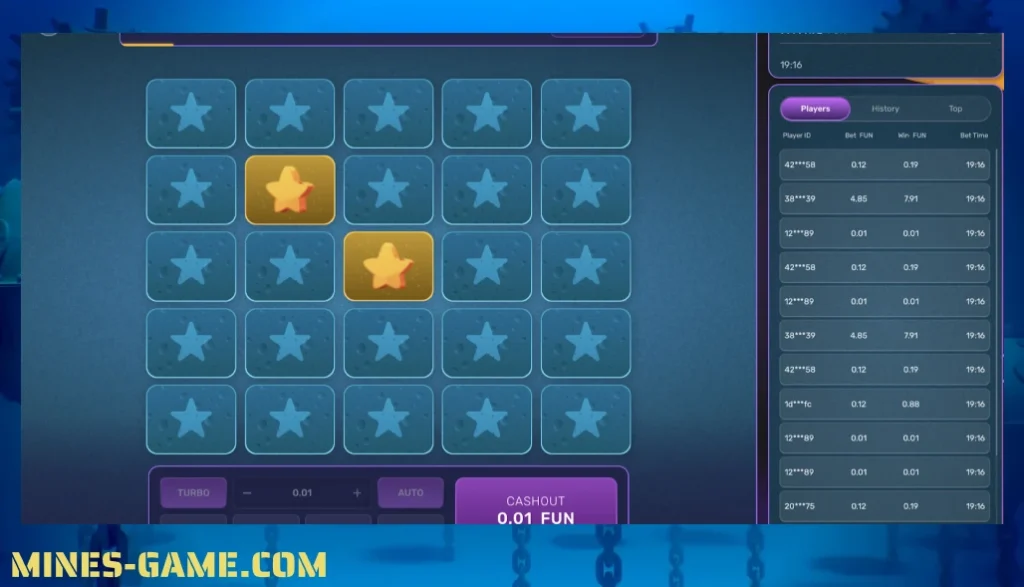
Any player who studies luck-based games will discover Turbo Mines a captivating subject. It’s a game that wraps probability in easy clickable tiles. At its essence, it’s a mathematical problem. Every move you make is a risk with changing odds. Understanding those numbers doesn’t take away from the fun. It transforms how you play. You cease guessing and start making decisions. This article will cover the fundamental math that runs Turbo Mines. We’ll explore how your chances vary with each click and look at ways to handle the grid strategically. The aim is to offer you the knowledge to see the game for what it is and to make your bets with more confidence.

Comparing Turbo Mines against Traditional Minesweeper
This contrast feels obvious, but the two games are essentially distinct in how they leverage clues and odds. Traditional Minesweeper is a puzzle of pure deduction. Click a safe tile and it reveals a number indicating how many mines surround it. This provides you with exact spatial clues to deduce where mines are located. You employ probability only when logic runs out. Turbo Mines, meanwhile, is a game of pure odds and risk control. You get no spatial clues. The only figures that matter are the aggregate numbers: starting cells, initial mines, and revealed tiles.
- Type of Information: Traditional Minesweeper offers locational, reasoning cues. Turbo Mines gives only aggregate statistical information.
- How Skills Are Used: Traditional Minesweeper favors logical analysis and pattern recognition. Turbo Mines favors probability assessment and emotional discipline.
- Determinism of Outcomes: In Traditional Minesweeper, a flawlessly deductive player can win every time. In Turbo Mines, even an optimal strategist cannot guarantee a win on any individual round. The unpredictability of the first tap after a payout decision makes it not feasible.
This distinction is vital. If you treat Turbo Mines as a deduction game, you’ll get frustrated. You have to accept it for what it is: a progressive betting game where numbers shape your risks, but luck determines each spin.
Understanding the Core Game Mechanics
To start, let’s become clear how Turbo Mines actually works. You see a grid of tiles. A certain number of mines are hidden behind them. Your goal is to tap tiles one in sequence without striking a mine. Every safe tile shows a multiplier that grows your eventual win. You can cash out anytime to secure that multiplier, or you can proceed. The key difference from classic Minesweeper is the lack of “number clues.” You have no hints about adjacent mines. Each new safe tile is an isolated event based purely on what’s remaining in the pool: leftover tiles and mines. This setup creates a straightforward probability problem. Your only information is how several tiles you’ve opened and how several mines were positioned at the start.
Critical Variables in Any Round
Every round of Turbo Mines begins with a couple of determined numbers. The grid size, say 5×5, provides 25 overall tiles. The number of mines is also fixed from the start—for illustration, 5 mines in that 25-tile grid. From your opening click, these numbers start to interplay. Your initial chance of hitting a mine is simply (Number of Mines) / (Total Tiles). But that chance doesn’t stay still. It shifts with every safe uncovering because the pool of still available tiles gets diminished. This isn’t a game of drawing with replacement. Each pick affects the next, a classic case of dependent probability. Observing these shifting odds is the stage at which strategic play commences.
The Collect Decision Stage
This is the point at which strategy actually matters. The game dangles a growing multiplier in your view, but the danger rises at the very time. Not a single strategy can assure a profit. Each round is its own isolated puzzle of risk and reward. You can calculate the mathematical expectation, but the consequence is consistently binary: you one of two ways cash out and win, or you hit a mine and forfeit your stake. So, grasping the mechanics comes down to handling that push and pull between greed and caution. Your guide through that tension is the set of cold, hard numbers that define your chances at any single step.
The way Probability Changes At Each Click
The changing odds are what make Turbo Mines so engaging to think about. Every click that doesn’t conclude the game gives you perfect information. You know the exact total of tiles left and the unchanged number of mines left. Let’s expand our example. Say you’ve successfully uncovered 5 safe tiles. Now, 20 tiles remain, with 5 mines still buried. The likelihood your next click strikes a mine is 5/20, or 25%. If you confidently open 10 safe tiles, 15 tiles are left with 5 mines. That makes the probability 5/15, or 33.33%. This progression is not linear in how it feels. The leap from 20% to 33% is a substantial boost in danger.
Mapping the Risk Curve
It helps to imagine this as a curve. The risk begins at a fixed point, for instance 20%, and climbs slowly at first. Then it becomes steeper as the number of safe tiles shrinks. Imagine opening 15 safe tiles in our 5-mine, 25-tile scenario. Only 10 tiles would remain. The chance the next tile is a mine is now 5/10—a straight 50/50 coin flip. This is a major emotional threshold. The reward might look very appealing here, but you’re literally betting on a coin flip. Understanding this curve enables you to set personal risk limits before you even start playing. That’s a indication of a disciplined strategy.
The function of RNG and game integrity
Any discerning player will ask: “Are the results truly random?” In electronic games like Turbo Mines, outcomes come from a Random Number Generator (RNG). A well-constructed and audited RNG ensures each tile’s status as a mine or safe is determined randomly when the round starts. There’s no pattern to predict. This is the foundation of fair play. For you, it means the probability calculations we’re talking about are valid models of how the game behaves. “Hot streaks” or being “due for a loss” are not real. The odds for each click are determined purely by the remaining tiles and mines at that exact instant.
Recognizing the RNG drives everything supports using probability-based strategy over superstition. You can’t outsmart a genuinely random sequence. Your edge comes from directing your decisions inside the known statistical framework. Reputable gaming platforms use provably fair systems where you can verify the randomness. As a player, knowing the game uses a certified RNG lets you trust the math you apply. It transforms your mindset from hoping for luck to executing a plan based on calculable risk. That’s a stronger, more satisfying way to play.
The Fundamental Math of First Probability
Let’s commence with the easiest part. Visualize beginning a game on a 5×5 grid with 5 mines. On your first click, with all tiles untouched, you have 25 options. Five of them are mines. Your chance of hitting a mine right away is 5/25. That breaks down to 1/5, or 20%. Your odds of picking a safe tile is 20/25, or 80%. This is easy arithmetic. The multiplier value shown on that first safe tile is set by the game’s own model. It isn’t a direct result of this probability. Keep the idea of survival chance separate from the reward multiplier. They’re connected in terms of risk, but the game calculates them independently.
This initial probability is the only time the math stays this straightforward. Once you reveal a safe tile, everything changes. You now have 24 tiles left, but the number of mines is still 5 (assuming you didn’t hit one). The new chance of hitting a mine on your next click becomes 5/24. That’s about 20.83%. The chance of safety is 19/24, roughly 79.17%. Observe the risk has gone up, just a little. This small uptick in danger continues with every safe click. This is the core mathematical rule of Turbo Mines: with every safe step forward, the path behind you vanishes, and the path ahead gets statistically more dangerous.
Tactical Methods Based on Odds
With the math as our foundation, we can explore real strategies. The central strategic decision in Turbo Mines is when to cash out. Since risk increases with every tile, a conservative plan involves setting a low target multiplier and cashing out regularly. For instance, you might opt to always cash out after 3 safe tiles. This gives you a high probability of success on any single round, but your wins will be more modest. An aggressive strategy targets higher multipliers, accepting the much lower likelihood of getting there.
- The Fixed Target Strategy: Choose a multiplier ahead of time, like 5x. Always cash out the instant you reach it, no matter how you feel. This forces control.
- The Percentage Risk Strategy: Set a maximum acceptable risk percentage. Figure out how many safe tiles that corresponds to. If you don’t want more than a 30% failure chance, cash out at the point where the risk hits that mark.
- The Progressive Adjustment Strategy: Commence with a conservative target. After a successful cash-out, use some of the profit to support a more aggressive try on the next round. This keeps your original bankroll protected.
No strategy removes risk. They only help you manage it. The key is to select one that matches your goals and then stick to it. This avoids emotional decisions in the midst of the moment, which usually cause chasing losses or giving back winnings.
Determining Expected Value (EV) for Approach
Chance shows the probability of something happening. Expected Value (EV) indicates what that happening is priced at on typical over many, many attempts. In Turbo Mines, at any junction, the EV is calculated by weighing the possible profit against the potential loss, multiplied by their probabilities. The formula is: EV = (Probability of Cashing Out * (Stake * Multiplier)) + (Probability of Hitting Mine * 0). Since triggering a mine results in zero, that latter portion often drops away. A more valuable pre-game computation relates to the probability of reaching a certain multiplier level.

For illustration, what’s the probability of safely opening 5 tiles in a line? In our normal scenario, it’s the result of each separate safe probability: (20/25) * (19/24) * (18/23) * (17/22) * (16/21) https://turbomines.net/. Work that out and you obtain roughly 0.20, a 20% likelihood. If the multiplier for 5 tiles is, say, 3x, then the EV for attempting to reach that point from the outset is (Probability of Success * (3x Stake)). This is a basic framework. The true game’s payout framework has more complexity. But the principle is key. A positive EV suggests a move that would be profitable over endless repetitions. Recall, each round is independent, and variance can be wild over a short session.
Why EV Alone Isn’t a Ideal Guide
Leaning only on EV has drawbacks in a activity like this. Firstly, the estimate presumes you are aware of the specific multiplier increments, and these can vary. Secondly, and more crucial, it disregards your own comfort with uncertainty and the scale of your capital. A plan with a small positive EV might drive you through long stretches where a solitary loss wipes out your session stake. I view EV as a theoretical reference, not a rigid directive. It indicates to me if the game’s offered multipliers are fairly set against the statistical hazard. That assists spot times where playing more aggressive or more conservative might make sense.
Frequent Misconceptions Concerning Odds of Mines Games
Several stubborn myths can wreak havoc with a user’s judgment. The main is the “Gambler’s Fallacy”: the idea that after a string of safe tiles, a mine must appear. This is entirely false. If you have remaining 10 tiles containing 3 mines, the probability for the next tile remains 3/10 (30%). It makes no difference what transpired on the previous 15 tiles. The past doesn’t affect the independent random event of the next click. An additional mistaken belief suggests specific tile positions are “safer”. Across a grid using a truly random mine placement, every unclicked tile holds the same probability of containing a mine, given the current remaining mine count.
The Illusion of Control
Players often adopt rituals or patterns, such as consistently beginning from a corner, thinking it changes their luck. This is an illusion of control. While you select which specific tile to click first, the mine layout is determined randomly prior to that click. Clicking the top-left tile instead of the center tile fails to shift the overall starting probability for that click. Identifying and dismissing these misconceptions is crucial for clear, math-based thinking. It discourages you from making choices rooted in imaginary patterns and directs your focus upon the variables you can actually control: your cash-out point and your stake size.
Useful Advice for Putting This Knowledge into Practice
So how does one bring all this theory to the digital grid? First, always check the game settings at the start: grid size and mine count. Do the quick mental math for the starting risk (mines divided by tiles). Second, determine your strategy before your first click. Are you going for small, frequent wins, or shooting for a high multiplier? Establish a clear cash-out point based on a tile count or a risk percentage. Third, handle your bankroll without mercy. Never stake more on one round than you’re willing to lose. Even a 95% safe chance still fails 1 in 20 times.
- Start Small: Use the lowest allowed stake to test the multiplier steps and see how you react emotionally to the rising risk.
- Use a Probability Cheat Sheet: Keep a simple table nearby. For a common setup like 5 mines in 25 tiles, keep in mind: after 5 safe tiles, risk is 25%; after 10, it’s 33%; after 15, it’s 50%.
- Practice Disciplined Exits: When your pre-set target is hit, collect. Right then. Don’t let the next multiplier tempt you. The mathematical jump in risk is rarely worth the extra reward.
- Review Sessions: Reflect on your play not in terms of wins and losses, but on whether you stuck to your planned strategy. This fosters discipline for the long run.
The goal of understanding the math isn’t to “beat” the game in a surefire way. It’s to make informed choices, control what you expect to happen, and appreciate engaging with a well-designed system of chance. When you frame each click as a probability calculation, you shift your play from reactive to proactive. That’s what a smart player does.